It's my good friend Rachel's birthday today, and seeing as she LOVES Harry Potter, I thought I would share this for her:
The Very Last Harry Potter Deleted Scenes You Will Ever See at Io9
Harry Potter Shrine and Etsy Treasury at Geek Crafts
Sorting Hat at Mr X Stitch
And something to keep her busy over her holiday: Butterbeer Cupcakes at Easy Baked
Big hugs Rachel!

Friday, November 25, 2011

Wednesday, November 16, 2011
Indexing
Hi all, just a short note to draw your attention to the fact that I've indexed the recipes; book and dvd reviews; and craft posts I've put up on this little blog. I didn't realise how many recipes I've stored here, both of my own and just links to recipes I wanted to come back to. I also didn't realise how light I've been on posting about the crafts I do (or did... before I started my job), so I'll have to rectify that, methinks. One day when I have more than one day off a week (I had Friday off and it was the first day that the library had been open in a month that I hadn't been there!). So, if you know I posted about something and want to read it again, just click on the links above, easy peasy.
Saturday, November 12, 2011
Lemon Honey Chicken
While you wait on the edge of your seat for my review of To Say Nothing of the Dog by Connie Willis (that you didn't even know you would be getting), here's a link to the Women in Science Fiction book club's discussion of Farthing (that you may remember from this post). And also, this is what we had for dinner tonight:
Juice and zest of half a lemon
2 heaped t honey (or a good squeeze of liquid honey)
Pinch white pepper
1t dried thyme
1t rubbed rosemary
Pinch of turmeric
2 spring onions
1-2t unsalted butter
Put everything into a small pot on low heat to melt the honey and soften the spring onion. Meanwhile, brown some chicken, then pour the warm sauce over the top, pop in the butter, and cover with a lid or a sheet of tin foil.
Serve on rice.
I've been told by my doctor that I have high blood pressure for my age, so I should cut out all salt until it's normal again. This is bizarre to me as we don't add salt to our food or eat many obviously salty things. We also steer away from processed food, instead making our own sauces (as you may notice from what I write about food on here).
However, apparently a good portion of your daily salt intake can come from bread, so I'm going to try making bread without salt tomorrow. I've done a little research and it seems that the salt in bread is only for flavour, with one person saying that one would find that salt-free bread would taste like cardboard. But apparently it is also a yeast inhibitor (unlike sugar, which is just as yummy to yeast as it is to us), meaning that a salt free bread may need less yeast. Interesting right?
Other places one can find sneaky salt is in cereal (Mum looked in the supermarket today and couldn't find anything other than porridge that had no salt in it, but ew); dried fruit; tinned fruit, vegetables, and fish; and shop-bought baking. As you can imagine, I've not had much other than fruit to eat today! Wish me luck for the next week, I'm going to need it!
PS: Sorry for the lack of photo, I'm only a wee while away from getting my camera. I'd have it by now, but noone around here seems to know about the specials they publish in their mailers... So be patient, I'll pop a photo in next time we make it!
Thursday, November 3, 2011
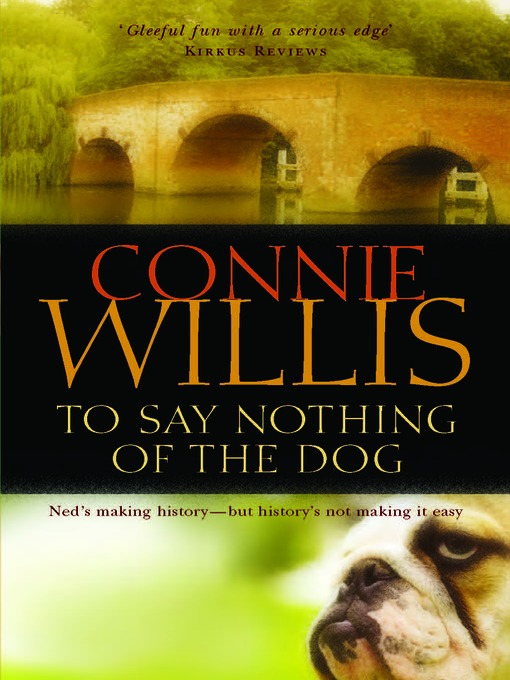
Book Review: Connie Willis' To Say Nothing of the Dog (and Fire Watch)
It's official, I love Connie Willis. Yes, I know, I'm only three books into her repertoire, but until I find evidence against it, I stick by my statement. This is the second novel in the Time Traveling Oxfordians universe (I don't think the series has a title...), and is almost the polar opposite of Doomsday Book in tone, setting, and characterisation.
Ned is busy in the past trying to find out what happened to the monstrosity that is the Bishop's Bird Stump, last seen in Coventry Cathedral before its bombing in 1940. This almost impossible task has been set him by Lady Shrapnell, who has basically taken over the history department (with her 'generous donations') to aid her in recreating the Cathedral exactly as it was moments before the bombing.
Because of the number of drops (ie time traveling trips) Ned has done in a short amount of time, he becomes ill with time-lag, causing "Maudlin sentimentality, difficulty in distinguishing sounds, fatigue... tendency to become distracted by irrelevancies. Slowness in answering. Blurred vision" and his almost being hit by a steam locomotive. The only cure for this is rest, but because of Lady Shrapnell, that just wont happen in (Ned's present) 2057, so Mr Dunworthy (yes, the very same from Doomsday Book and Fire Watch) sends him to 1888. Where else could be more relaxing - punting on the Thames, playing croquet, and drinking tea. Except that Mr Dunworthy has set Ned a task, something that Ned has since forgotten due to the time-lag. And here's where the spoilers start! Click the picture below for a much shorter than usual review...
I think it takes a really skilled author to be both entertaining and thought-provoking, especially in both a lighthearted story and a serious story. If you found Doomsday Book too heavy to finish, do try To Say Nothing of the Dog. Also, give her short stories a try. I dug Fire Watch out of the library's stack (it was published in 1984) to read the Hugo and Nebula award-winning titular story, set in the same universe as Doomsday Book, To Say Nothing of the Dog, and Blackout/All Clear (which I'll definitely be reading soon*), and read on through the rest of the stories. I found A Letter from the Clearys (Nebula award winner), And Come from Miles Around, and Service for the Burial of the Dead the most enjoyable, though the imagery of Daisy in the Sun (Hugo award nominee) has stayed with me.
*Because this has been sitting in my draft-posts for so long, I'm now actually on to reading Blackout. I'm only three or four chapters in and I'm already hooked. I don't think it's a spoiler to say Colin (from Doomsday Book) makes an appearance!
Monday, October 31, 2011
Happy Hallowe'en!!
Hi everyone, yes I'm still alive, though only barely after a week of full time (33 hours 45 minutes, not including the fact that I get paid for public holidays!) work. I have decided I need to put in some effort to keep up my blog again, and so here's a non-scary little Hallowe'en story for you, written by me, and inspired by this picture from The Lady Lair.

Hidden behind some willows at a bend in the stream is an old wooden jetty leading up to an old stone cottage. In Autumn, the leaves turn red and golden brown and yellow and the trees stand in a colourful blanket that covers the river-smoothed rocks and in places the drifts reach up and over the jetty. The only way to read the cottage is by rowboat up to this jetty, then by carefully stepping log to log and plank to plank up the jetty that turns into a set of rickety stairs up to the courtyard in front of the big blue front door of the house. The cobblestones here are weathered, but smooth, and free of leaves as if someone had only recently swept them all away. But noone comes here anymore, and the door creaks as a breeze blows through; it is never locked. On the other side of the door, the sunlight streams, not through the windows, which, though intact, have grown cloudy with dirt, but down from the gaps in the green-tiled roof. The floor is dusty and in places covered in moss and lichen, and further into the house the light dims under the intact sections of roof. The kitchen smells faintly of damp, but the stove is intact, and a small bundle of wood still sits next to it in an indestructible basket made of willow saplings. In the corner of the kitchen is a door, and on the other side another courtyard with a stone well, and beyond, a glade of elm and birch trees, where a child's swing hangs, forlorn, from one rope.
But instead of this melancholy scene, a scene that only hints at happier times, you see the sparkling lights and hear the choral voices of the faerie who have taken this place as their own, and you gaze in childlike wonder. You see fae children lined up across the swing, playing clapping games and laughing. You see the hearth in full flame, and warm your hands, while a small stout woman stirs a pot of fragrant stew on top. You see that the lichen and moss are gardens of flowers and vegetables, with fae of all sizes tending them and singing a working song. To stay and watch too long is not advised, so with reluctance, you turn away, open the big blue door, and cross the neatly swept courtyard. But before you step back into your little row boat, you kick up the red and golden brown and yellow leaves so that they fall about you in a flurry of colour, and grin, knowing that you'll never tell a soul about the old stone cottage at the end of the old wooden jetty hidden behind the willows in the bend in the stream.
Subscribe to:
Posts (Atom)
LinkWithin
